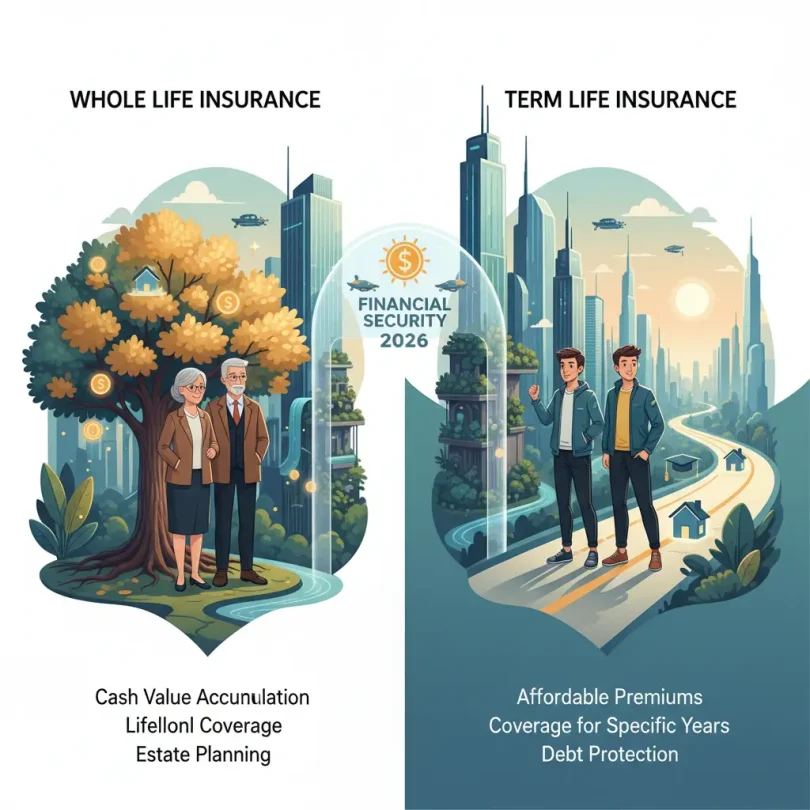

In the current 2026 financial climate—marked by the implementation of the One Big Beautiful Bill Act (OBBBA) and shifting estate tax exemptions—life insurance has evolved from a simple safety net into a sophisticated instrument for Wealth Preservation.
For the average earner, life insurance is a “just in case” expense. But for High-Net-Worth Individuals (HNWIs), it is a strategic asset class. The debate between Term Life and Whole Life (Permanent) insurance is no longer about “price”; it is about Internal Rate of Return (IRR) and Tax-Free Liquidity.
1. Term Life Insurance: The Tactical Utility Play
In 2026, Term Life is often described as “renting” protection. You pay for a specific duration—typically 10, 20, or 30 years—and if the policyholder passes away during that window, the beneficiaries receive a tax-free lump sum.
- The 2026 Strategy: “Buy Term and Invest the Rest” (BTIR) remains popular for young professionals. Because premiums are significantly lower (often $50/month vs. $800/month for Whole Life), the savings can be funneled into high-yield ETFs or crypto-managed accounts.
- The Downside: In 2026, medical underwriting has become more rigorous. If you outlive your 20-year term, renewing at age 55 or 60 can be cost-prohibitive or impossible due to health changes.
- Best For: Replacing “human capital” (future salary) for families with young children and mortgages.
2. Whole Life Insurance: The Institutional Wealth Anchor
Whole Life is a permanent contract that combines a death benefit with a Cash Value component. In 2026, HNWIs are using Whole Life as a “Volatility Buffer.”
- Guaranteed Growth: Unlike the stock market, the cash value in a Whole Life policy grows at a guaranteed rate (typically 3%–4.5% in 2026) plus non-guaranteed dividends from mutual companies.
- Tax-Free Access: Through a strategy known as “Bank on Yourself,” you can take loans against your policy’s cash value to fund real estate deals or business expansions. The money continues to grow as if you never touched it, creating a “Double Compounding” effect.
- Estate Liquidity: When you die, your heirs may face a massive tax bill (the “Death Tax”). Whole Life provides the immediate cash needed to pay the IRS so your heirs don’t have to sell the family business or real estate at a discount.
3. The 2026 Comparison: Term vs. Whole Life
| Feature | Term Life Insurance | Whole Life (Permanent) |
| Duration | Fixed Term (10–30 years) | Lifelong (Until age 121) |
| Premium | Low & Fixed | High & Fixed |
| Cash Value | None | Builds over time (Tax-Deferred) |
| Primary Use | Income Replacement | Estate Planning / Tax Alpha |
| Market Risk | Zero | Zero (Guaranteed) |
4. Advanced 2026 Strategies for Wealth Preservation
The “Convertible” Bridge
Many savvy investors in 2026 are buying Convertible Term policies. This allows you to lock in a low rate while you are young and healthy, with the contractual right to convert it into a Whole Life policy later—without a new medical exam. This is a “hedge” against future uninsurability.
Using Life Insurance for “Human Capital” Protection
In 2026, the concept of Human Capital (the total value of your future earnings) is central to wealth management. If you are a 40-year-old executive earning $500k/year, you have roughly $10M–$15M in human capital. A Whole Life policy preserves this value even if you can no longer work, as the cash value can be used as a supplemental retirement fund.
The Special Needs Trust
For families with dependents requiring lifelong care, Whole Life is the only viable option. It ensures that no matter when the parents pass away, a trust is instantly funded to provide for the child’s care, shielded from government “spend-down” rules.
5. Which Should You Choose?
Choose Term Life if:
- You have high debt (mortgage/loans) that will be paid off in 20 years.
- You are in the “Wealth Accumulation” phase and need every dollar for investments.
- You only need coverage until your children are financially independent.
Choose Whole Life if:
- You have maxed out your 401(k), IRA, and HSA and need another tax-advantaged bucket.
- You want to leave a guaranteed, tax-free legacy to heirs or charity.
- You want a “safe” asset that is uncorrelated with the stock market.
- You have an estate valued near or above the $15M federal exemption.
Final Verdict for 2026
The most successful wealth plans in 2026 often use a Hybrid Approach: a large Term policy to cover the high-risk years of early parenthood, and a smaller, high-cash-value Whole Life policy to serve as a lifelong tax-free bank and estate planning tool.